
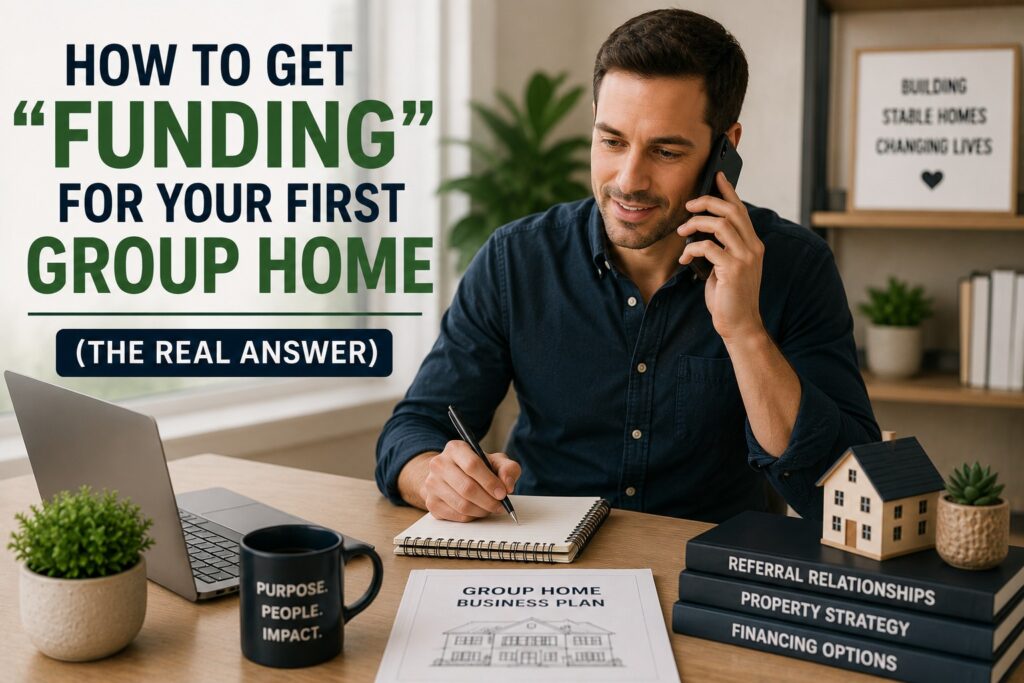
Group home funding isn’t about finding the perfect grant or loan. If you’ve been searching for a grant, a loan program, or a secret application that unlocks funding for your first group home, stop searching.
It doesn’t exist. And even if it did, you wouldn’t need it.
The real way to fund your first group home isn’t financial. It’s relational. And once you understand this distinction, everything about getting started in this business changes.
The Question Most People Ask
We get some version of this question every single day: “How do I get funding to get my first home?”
But here’s what people are really asking underneath that: “How do I start this business without risking money I don’t have?”
That’s actually a smart question — and the answer is better than most people expect.
What You Actually Need First
Think about it this way. Even if someone handed you a fully furnished property tomorrow — keys, furniture, supplies, everything — what would you actually do next?
You’d need systems to manage the people once they move in. And you’d need the actual people who can pay.
That’s the work. And it has to happen no matter what. So the only question is: why not do it first?
The $90 Billion You’re Ignoring
There is roughly $90 billion flowing from the federal government to housing and social service agencies across the country every single year.
Nonprofits. Rapid rehousing programs. Veterans organizations. Mental health agencies. Transitional housing programs.
These organizations have the clients, the funding, and the urgent need for exactly what you’re planning to provide. They are actively looking for housing partners right now, in your market.
That is your funding. Not a loan. Not a grant application. Not a licensing process.
Why Most People Get This Backwards
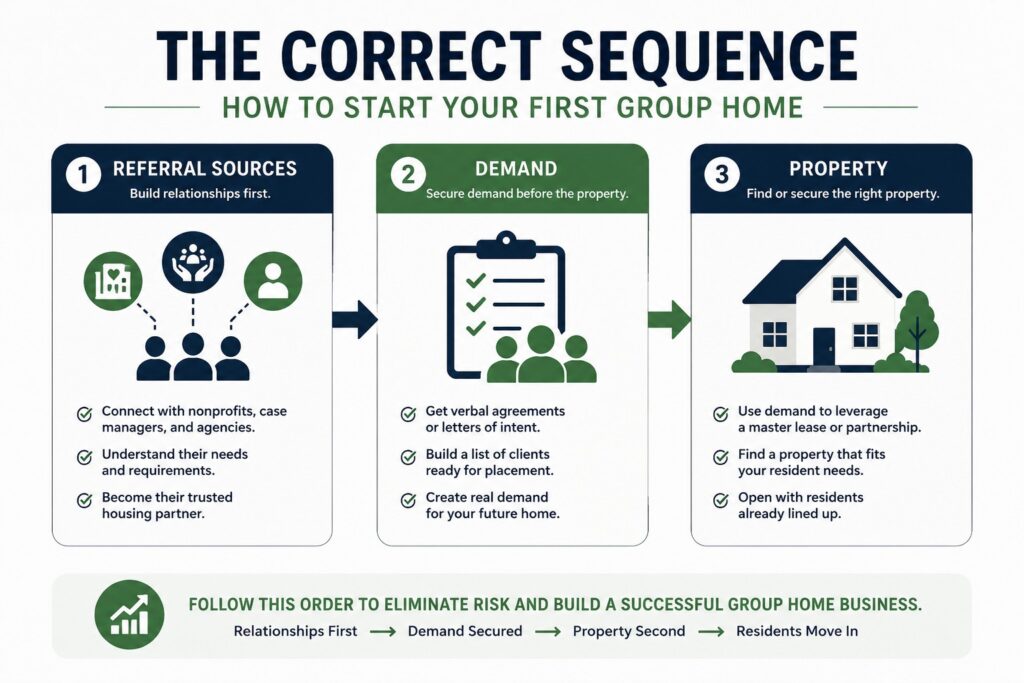
The most common mistake new operators make is finding a property first and then trying to figure out how to fill it. We’ve watched people sit on empty houses for months because they had the real estate before they had the relationships.
Our most successful students do it the other way around. They build referral source relationships first — with case managers, discharge planners, probation officers, shelter directors — and let the demand stack up before they ever sign a lease or shake a landlord’s hand.
By the time they’re ready for a property, they’re not asking for a favor. They’re showing up with people already lined up and ready to move in. That changes every conversation.
What This Looks Like in Practice
Jasmine from Detroit was homeless with three kids when she started this process. She didn’t start by looking for a property. She spent weeks studying the marketing side of the business, volunteering at a transitional housing facility, and building relationships with local organizations.
By the time she called a landlord with a vacant property, she wasn’t a stranger asking for a chance. She had people ready to move in. The landlord ended up chasing her to close the deal.
Her total out-of-pocket investment to launch: a few hundred dollars for an LLC. The property came through a straight partnership — no deposit, no lease, no money down.
Saeed came to the U.S. from Ghana as a teenager with $2 in his pocket. He had a property before he had the marketing figured out — and it sat empty for a month because of it. The second he built referral relationships using the steps we teach, everything changed. Seven properties in five months followed.
What You Need to Get Started
You don’t need perfect credit. You don’t need $50,000 saved. You don’t need a license.
You need:
→ A basic understanding of the business model
→ The ability to pick up the phone and have conversations with local organizations
→ Some business systems in place for when the residents start arriving
→ The drive to put yourself in the position of an asset, not a liability
When you walk into a conversation with a landlord or investor having already built referral relationships, already knowing what organizations in your area are willing to pay and how many clients they’re ready to send — you become someone they want to work with. Not someone they’re taking a chance on.
The Bottom Line
The “funding” for your first group home is already out there. It just doesn’t look like a bank account. It looks like a case manager at a local nonprofit who has 12 clients she’s desperately trying to house right now.
Go find her first. The property comes after.
Get the Free Course HERE — No Credit Card, No Obligation
Our free 5-part course walks you through the exact steps to identify referral sources in your market, what to say when you call them, and how to set up the basic systems you’ll need before you ever sign a lease. Drop your email below to get started.
You’re not building your group home business alone. Join our free Skool community of 2,000+ members to ask questions, learn from experienced operators, share your progress, and connect with others on the same path.
