
Group home business for beginners starts with understanding how the model really works—not the myths you often find online. If you’re considering opening your first group home, this guide explains what you need, what you don’t need, and the proven process successful operators use to build a sustainable business.
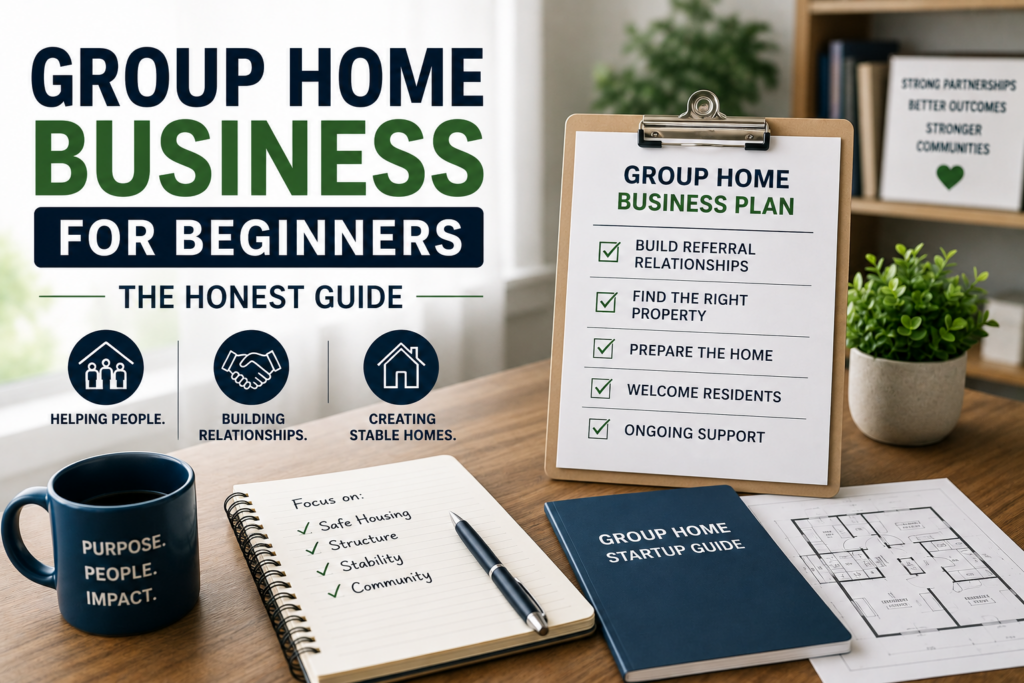
Group Home Business for Beginners: The Honest Guide
There’s a version of this guide that leads with income screenshots and student testimonials and makes the group home business sound like a passive income machine you can set up in a weekend.
This isn’t that guide.
We’ve been in this business for over 20 years. We’ve helped thousands of students open group homes across the country. And we know that the people who succeed aren’t the ones who were sold a dream — they’re the ones who understood what they were getting into and decided it was worth it.
Here’s the real picture.
What the Group Home Business Actually Is
You are a housing operator. You find and manage residential properties — four to six bedroom homes — and provide structured housing for people who need it: people in recovery, seniors, veterans, individuals with disabilities or on fixed incomes.
You are not a caregiver. You are not a counselor. You are not running a medical facility. The clinical care, social services, and support programs your residents need come from the nonprofits and social service organizations that refer them to you. Those organizations bring a full support ecosystem — caseworkers, health services, counseling, job placement, rehabilitation programs — that stays engaged after your resident moves in.
Your job is to provide a safe, stable, well-managed home and to maintain the referral relationships that keep it full.
What’s Easier Than You Think
The licensing piece: For the housing provider model, you do not need a healthcare license in most states. Federal Fair Housing law protects this model and the people it serves. You are a residential housing provider, not a healthcare operator.
The capital piece: You don’t need a large amount of money to start. The master lease model lets you get started with first month, last month, deposit, and furnishings. The partnership model — where a property owner contributes the asset in exchange for a revenue share — can bring that number to zero. The barrier to entry is knowledge, not capital.
The demand piece: The market is undersupplied. Every city in this country has more people needing group home placements than available beds. Referral organizations are actively looking for operators they can trust. When you show up and introduce yourself, you are solving a problem they have right now.
What Actually Takes Work
Building referral relationships: This is the most important thing you will do, and it takes time. Reaching out to nonprofits, social service agencies, outpatient programs, case managers, and recovery organizations. Building trust. Following up. Becoming the person they call first when they have a placement need.
This is not hard work. But it is consistent work. And it is the work that happens before you have a property — which is exactly when most beginners aren’t doing it.
Finding the right property: A good group home property is large enough to generate real revenue, located in a neighborhood where zoning permits this use, and priced (or structured) in a way that leaves healthy margin. Those three things don’t always come together quickly.
Staying consistent through the setup phase: The period between “I’m doing this” and “I have my first resident” is where most beginners stall. There’s no external accountability. No paycheck. Just the process. The students who push through this phase with a clear playbook — and ideally a community and a coach — are the ones who open their first home.
The Right Order of Operations
Step one: Build referral relationships with organizations in your area that serve your target population. Get to know them. Understand what they need in a housing partner. If possible, get a verbal agreement or a letter of intent before you have a property.
Step two: Use those relationships as leverage to secure a property — through a master lease or a partnership with a property owner who wants their asset performing better.
Step three: Open with residents already lined up. Not scrambling to fill beds. Not paying a lease on an empty house. Launching with a waitlist.
That order is not accidental. It eliminates the biggest risks beginners face — vacancy, financial pressure, and the confidence crisis that comes from having a house and no residents.
What You Don’t Need
- Experience in healthcare or social services
- A real estate license
- A medical background
- A large amount of startup capital
- An existing network in the industry
Every one of our students started without at least one of these. Many started without all of them.
Where to Start
Start with the free course. It covers the legal framework, the financial model, the referral relationship strategy, and the property acquisition path. It will give you a clear picture of whether this business is right for you before you commit to anything.
If you’re ready to move faster, the Gold Course goes deeper — and the Skool community gives you access to thousands of students who are actively building group home businesses, including many who have been exactly where you are right now.
The group home business is not for everyone. But for the person who wants to build real income, do meaningful work, and build something that runs without them being on the floor every day — it’s one of the best models available. And the operators who get started now, in a market that is still wide open, will be the ones who look back in three years and wonder why they waited.
Get the Free Course HERE a — No Credit Card, No Obligation
Join 2,000+ group home operators in our free Skool community — post wins, get strategy from active coaches, find local partners, and connect with people doing exactly what you’re trying to do. CLICK HERE
