
The demand for sober living housing in the United States has never been higher — and the supply has never been shorter.
If you’ve been looking at how to start a sober living home, you’re looking at one of the most recession-proof, mission-driven business opportunities available right now. Here’s everything you need to know.
What Is a Sober Living Home?
A sober living home is a group housing environment for people in recovery from addiction. Residents live together in a structured, substance-free environment while transitioning back into independent life.
Unlike licensed treatment facilities, sober living homes are housing businesses — not medical operations. You are providing a safe, stable home. You are not providing clinical treatment or medical care.
This distinction means:
- No license required in most states
- No clinical staff required
- No medical certifications needed
- Can be started with little to no money down.
Why Sober Living Is One of the Best Group Home Niches
High demand, low supply. The recovery housing market is dramatically undersupplied. Treatment centers and recovery programs have more clients needing housing than available beds. When you open a sober living home and connect with local treatment centers, you will not have a vacancy problem.
Referral sources are everywhere. Treatment centers, outpatient programs, AA/NA groups, case managers, and courts are all constantly looking for stable sober living placements. Build these relationships before you open and you’ll have a waitlist before you have a home.
Mission and money aligned. If you care about recovery — personally or professionally — this is a way to do meaningful work while building serious income.
How Much Does a Sober Living Home Make?
- Typical home: 4–6 bedrooms, 2 residents per room
- Revenue per bed: $500–$800/month depending on market
- Gross revenue: $5,000–$8,000+/month
- Operating costs: $2,500–$4,000/month
- Your net: $2,000–$4,000+/month per property
The model scales. Our student Andrew Lamb now operates 10 sober living homes — and he’s still growing.
Real Student Story: Andrew Lamb — 10 Sober Living Homes Across Two States
Andrew started with one sober living home in California. He learned the model, built his referral networks, and scaled methodically.
By the time he posted this update in our community, he was opening his 10th home — his first outside of California, in Massachusetts. The deal itself was structured creatively: two partners bought and rehabbed the property, refinanced with Andrew’s LLC on title as a 1/3 partner. His company operates the sober living business. 10 bedrooms. 20 beds.
“Creating massive cashflow while changing people’s lives.”
— Andrew Lamb
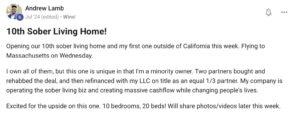
Andrew’s story illustrates two things: the sober living model works at scale, and there’s more than one way to structure a deal. You don’t have to own the property or do it alone.
Do You Need a License for a Sober Living Home?
In most states, no. Sober living homes are protected as housing businesses under the federal Fair Housing Act and the Americans with Disabilities Act, which recognize people in recovery as
a protected class.
Local governments cannot zone out or unfairly restrict sober living homes from residential neighborhoods. The legal framework is on your side.
Regulations vary by state. The Gold Course includes a full breakdown of the legal framework, the letter we’ve used successfully to handle code enforcement issues, and case studies from operators across the US.
How to Start a Sober Living Home With No Money
The master lease model works exceptionally well for sober living:
- Connect with local treatment centers and recovery programs as your referral sources. Do this until you feel confident you could fill up a home
- Find a landlord with a 4–6 bedroom home in a residential neighborhood
- Approach them with a long-term lease offer — stable, reliable tenant, property maintained
- Lease the home and operate it as a sober living residence
- Fill your beds, collect your income, hire a house manager to run day-to-day operations
You don’t need to own the property. You don’t need a large upfront investment. You need the business model and the relationships.
Your First Step
Build your referral source list before anything else. Call local treatment centers, outpatient programs, and recovery organizations. Tell them you’re opening a sober living home and you want to be a resource for their clients.
That one step — before you have a property, before you spend a dollar — is what separates operators who fill their homes immediately from those who sit with empty beds.
Start Here
The Group Home Riches free 5-part course includes everything you need to understand this business, find your first property, and get your first residents.
→ Get the Free 5-Part Course Here
Join 2,000+ group home operators in our free Skool community — post wins, get strategy from active coaches, find local partners, and connect with people doing exactly what you’re trying to do.
