
The cost to open a group home is often much lower than most people expect. While many assume they need $50,000 or more to get started, the reality depends on the business model you choose. In this guide, we’ll break down the real startup costs and show you how many successful operators launch with little—or even no—money out of pocket.
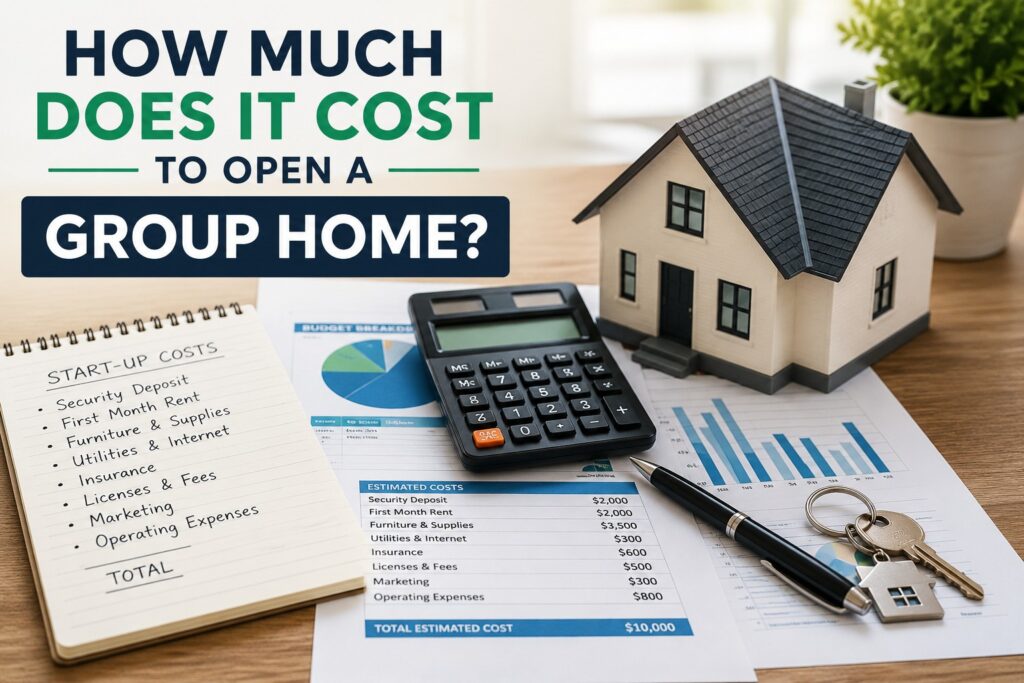
How Much Does It Cost to Open a Group Home?
The number most people expect to hear: $50,000. Maybe $100,000. Something that requires a small business loan, a co-signer, and a leap of faith.
The number that surprises them: sometimes zero.
Here’s the full breakdown of what it actually costs to open a group home — and the strategies our students use to launch with little to no money out of pocket.
The Two Paths: Lease vs. Partnership
Master Lease: You sign a lease with a landlord on a large residential property — four, five, or six bedrooms — and operate it as a group home. Upfront costs are first month’s rent, last month’s rent, a security deposit, and furnishings.
Depending on your market, that typically runs $5,000 to $20,000. In lower cost-of-living markets, you can get started for less. In major metros, more.
Partnership Agreement: You find a property owner who wants their asset performing better and structure a deal where they contribute the property and you contribute the operations and referral relationships. Revenue is split. No lease. No deposit. No furnishings cost out of pocket if you negotiate it right.
The partnership path is how students launch with $0 in startup capital. It requires something more valuable than money: proof that residents are already lined up.
Why Referral Relationships Change the Capital Equation
Here’s the part most startup guides leave out.
When you build relationships with referral organizations — nonprofits, social service agencies, outpatient programs, courts, case managers — before you have a property, you create leverage.
A verbal agreement from a case manager who will send you three residents when you open. A contract with a nonprofit that has a housing waitlist. A relationship with a recovery program that needs stable placements immediately.
That’s a business case. A property owner with a vacant home sees that and the conversation changes entirely. You’re not asking them to take a chance on you — you’re showing them demand that exists right now and offering them a share of it.
The referral relationship is the asset. You can build it for free.
This is why we teach referral relationships before property. Not just because it’s better business strategy — though it is — but because it fundamentally solves the startup capital problem.
What About Furnishings and Setup?
If you’re leasing, budget for furnishings. A group home bedroom doesn’t need to be luxurious, but it needs to be clean, functional, and livable — bed, dresser, basic storage. Common areas need seating, a kitchen table, basic appliances.
Most students furnish a home for $3,000 to $8,000 depending on size and market. Facebook Marketplace, estate sales, and bulk secondhand furniture sources keep costs low. Some students have negotiated furnishing costs into their partnership agreements, making even this cost disappear.
Do You Need a License? (And What That Costs)
For the housing provider model we teach — no license required, no licensing cost.
You are operating a residential housing business. Your residents’ clinical and social support services come through the referral organizations already working with them. Nonprofits and social service agencies that refer residents bring a full care infrastructure with them: caseworkers, health services, counseling, job placement support, and more. You provide the home. They provide the care network.
Federal Fair Housing law and the ADA protect this model and the people it serves.
Some operators eventually pursue licensed care facilities — a different, more complex path that carries real licensing and compliance costs. That’s a separate conversation for a later stage of growth.
What About Grants?
Yes, grants exist for group home operators. Some students access them. It’s a real part of the ecosystem.
But grants take time to research, apply for, and receive — and most require you to already be operating. We don’t recommend waiting on a grant to launch your first home. Get the business running. Build the track record. Then the grant conversation gets a lot easier
The Real Startup Cost Breakdown
- Education and training: $0 (free course + YouTube) to $199 (Gold Course) to higher for Done With You coaching
- Master lease deposit + first/last: $3,000–$15,000 depending on market
- Furnishings: $3,000–$8,000
- LLC formation and basic legal: $200–$500
- Licensing: $0 for the housing provider model
- Property (partnership model): $0 — property owner contributes the asset
Total realistic range: $500 to $25,000, with the wide variance driven almost entirely by market and deal structure. The partnership model compresses that number toward zero.
The Bottom Line on Startup Costs
Capital is not the barrier to entering this business. Knowledge and relationships are.
Students who know how to build referral relationships and structure property partnerships can launch with minimal or zero capital. Students who don’t know the model end up spending money on a property, furnishing it, and then struggling to fill it — which is the expensive version of this business.
Learn the model first. The money part takes care of itself.
Get the Free Course HERE and Learn the Model Before You Spend a Dollar
Join 2,000+ group home operators in our free Skool community — post wins, get strategy from active coaches, find local partners, and connect with people doing exactly what you’re trying to do.
